Morning Standups Are BS
Daily standups destroy developer productivity, whether they are at 9 AM or 11 AM. The fix is not a better time. It is no standup.
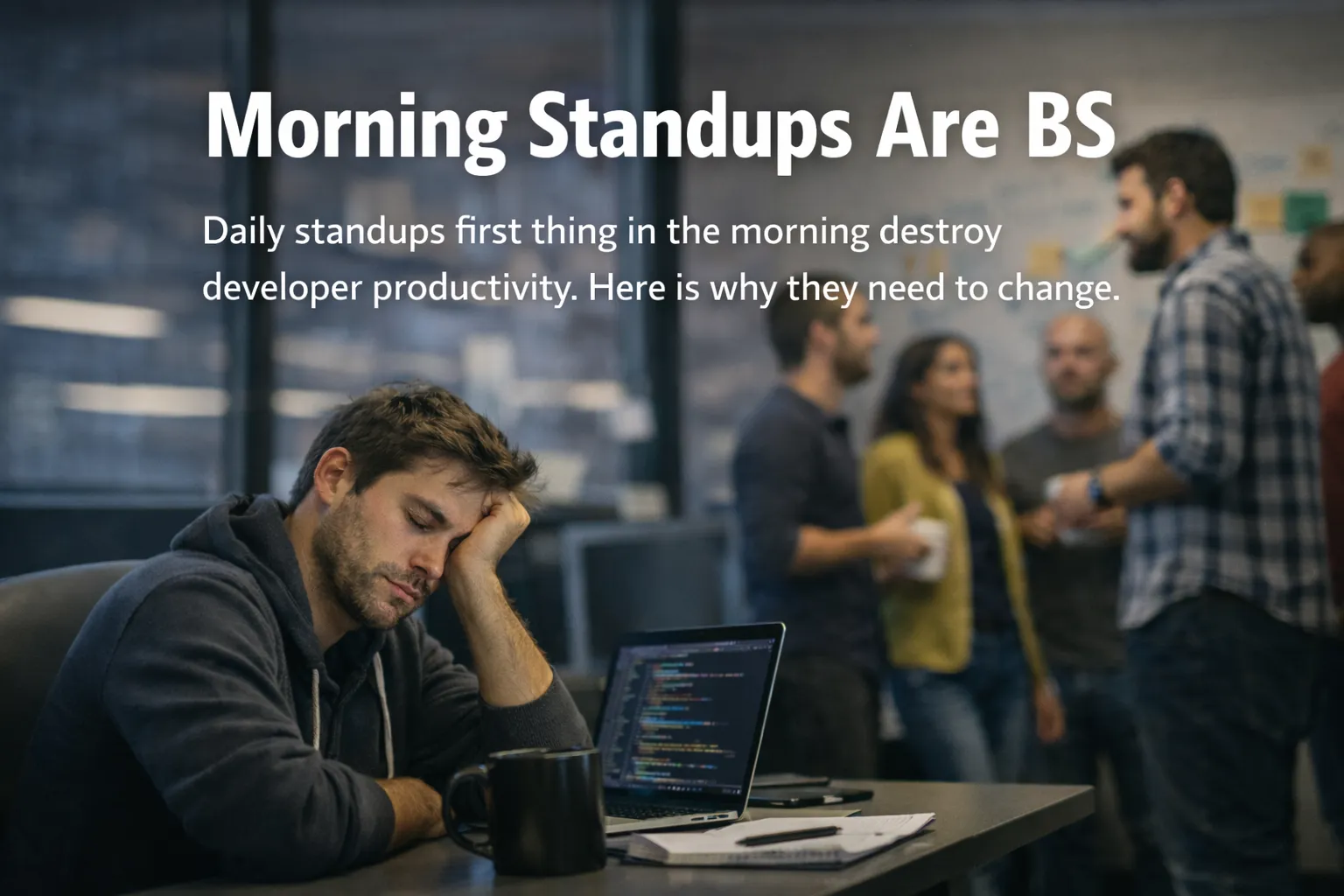
Morning Standups Are BS
9:00 AM standup. Every day. Non-negotiable.
Fifteen minutes that somehow costs the entire morning, and often the whole day.
Code is flowing. The problem is cracking open. Then Slack pings: “Standup in 5.”. Instant context murder.
It seems harmless. A quick sync. Everyone aligned. But the problem is not the time of day. The problem is the standup itself.
This is not a fringe opinion. Developer surveys and forums consistently point to meetings, especially status updates, as a major productivity drain and source of frustration. GitHub’s Good Day Project found that developers with three or more meetings per day have as low as a 14% chance of making meaningful progress, while Microsoft Research confirmed that developers cite meetings and interruptions as the primary reasons for bad workdays.
And yet: standup persists.
This Is Not a New Problem
Long before Slack, calendars, or agile rituals, writers were already complaining about the same thing: scheduled obligations destroy the conditions required for real thought.
They did not call them standups. They called them appointments, visits, obligations. The effect was identical.
Seneca: Time Is Stolen in Fragments
Seneca argued that life is not short by nature. It is made short by constant small demands imposed by others.
In On the Shortness of Life, he describes days broken into pieces by social duties, errands, and obligations. Time is not taken all at once. It is stolen in fragments. And once a day is fragmented, it cannot be used well.
The key idea is simple:
- A day divided cannot be lived deeply
- Small obligations ruin large stretches of time
- You lose not just the minutes, but the ability to use what remains
This is the earliest version of the argument. Meetings do not have to be long to be destructive. They only have to exist.
Schopenhauer: Thought Requires Unbroken Time
Arthur Schopenhauer was even more explicit.
He argued that serious thinking requires long, uninterrupted stretches of time. Anything that breaks those stretches makes deep thought impossible. Not inefficient. Impossible.
Crucially, he points out that anticipation alone is enough to do the damage.
If the mind knows it will soon be interrupted:
- It refuses to go deep
- It stays near the surface
- It avoids difficult problems
Schopenhauer treated appointments and social obligations as enemies of thought. Not because they take time, but because they cap depth in advance.
The interruption does not need to happen. The calendar entry is sufficient.
Kafka: The Day Is Already Ruined
Franz Kafka described the psychological version of this problem in his diaries.
Kafka repeatedly writes about days that feel ruined from the start because of a single upcoming obligation. Even a short meeting later in the day is enough to produce anxiety, paralysis, and drift hours beforehand.
Nothing meaningful happens before the appointment because the mind is already occupied by it.
You are not free to work.
You are not free to rest.
You are waiting.
Kafka captures the lived experience of standup culture perfectly. The damage happens before anyone joins the call.
Cioran: A Day Without Appointments Is Paradise
Emil Cioran distilled all of this into one brutal observation:
A day without appointments is a paradisiacal day.
Not because meetings are unpleasant, but because they destroy temporal freedom.
An appointment does not occupy fifteen minutes. It occupies the entire day.
Once it exists:
- You hesitate to start anything deep
- Time feels closed instead of open
- Work shrinks to fit the gaps around the obligation
Cioran understood that anticipation is often worse than the event itself. The knowledge that you will be pulled out of focus later prevents you from entering focus now.
This is exactly why daily standups are so damaging.
The meeting itself is short.
The mental damage lasts all day.
The Common Thread
Across centuries, the same conclusion appears again and again:
Deep work requires temporal openness.
Appointments destroy temporal openness.
Anticipation does as much damage as interruption.
Standup culture did not invent this problem. It industrialized it.
A fixed daily meeting places a ceiling on depth. It teaches the brain not to commit fully to hard problems, because it knows it will be interrupted on schedule.
The fix is not a better time.
The fix is removing the appointment.
The Real Problem: The Standup Itself
Moving It Later Does Not Fix It
Morning standups are bad. They torch peak focus, force artificial start times, and turn the first hour into a waiting room.
So teams “fix” it by moving standup to 10:30. Or 11. Or after lunch.
That just moves the damage.
You still lose a contiguous block of focus.
You still have a guaranteed daily interruption.
You still have a meeting that exists because “we’ve always had one,” not because it’s the best way to share status or unblock people.
Late-morning standup is just kabuki theatre with a later curtain call.
What Standups Actually Do
In theory, standups are for:
- Surfacing blockers
- Aligning the team
- Quick coordination
In practice, they’re usually:
- Status theatre (everyone says something so the ritual feels complete)
- Information that belongs in a thread or a doc
- Blockers that could have been raised and solved hours earlier
The genuinely useful parts, “I’m blocked on X”, “we need to sync on Y”, do not require a daily, synchronous, everyone-in-one-place ritual. They require the right person seeing the right message at the right time.
That does not require a meeting.
The Cost Is Always Higher Than It Looks
Whenever you schedule a daily standup:
- Someone’s deep-work block gets carved up
- Context switching multiplies (pre-meeting prep, the meeting itself, re-immersion after)
- The team optimizes for “having something to say at standup” instead of doing the work and communicating when it matters
The meeting is 15 minutes.
The cost is focus, flow, and the habit of relying on ritual instead of real communication.
Meeting Hangover
The damage does not end when the meeting ends.
There is cognitive residue. Your brain was just thinking about status, blockers, what you were going to say, and what other people said. Now you have to drag it back into the actual problem. That transition is not instant.
This is meeting hangover.
A 15-minute standup does not cost 15 minutes. It costs:
- The meeting itself
- The mental wind-up beforehand
- The slow wind-down afterward
For focused work, the real cost is often 30-45 minutes per person. GitHub’s research shows that developers with minimal interruptions have an 82% chance of a good day, but this drops to just 7% when interrupted throughout the day. Multiply that impact by every developer, every day, and you get a staggering cost hiding behind “just a quick sync.”
Why No-Meeting Days Work
Some companies experiment with no-meeting days, one or two days a week where nothing gets scheduled.
An MIT study of 76 companies found the results are dramatic:
- Two no-meeting days per week increased productivity by 71%
- Job satisfaction increased by 52%
- Stress and micromanagement both decreased
No-meeting days reveal something uncomfortable: meetings, including standups, are interruptions. When you remove them, people don’t flounder. They work. They communicate when they need to. They solve problems without waiting for a calendar slot.
If your team thrives on no-meeting days, ask the obvious question:
Why are we tolerating meetings on the other days?
The Micromanagement Illusion
A common defense of standup sounds reasonable:
“It helps me understand what everyone is working on.”
But that understanding is mostly imaginary.
Ask someone ten minutes later:
- “What did Alex say this morning?”
- “What is Priya actually working on right now?”
- “Who mentioned being blocked?”
Most people can’t tell you. Sometimes Alex wasn’t even there.
Standup creates the feeling of awareness, not actual awareness. Information is spoken once, mentally acknowledged, and immediately discarded.
If standup truly improved shared understanding, people would remember it. They don’t, because most of what’s said isn’t useful, persistent, or tied to decisions.
The Silent Majority: Developers (Mostly) Hate It
Let’s be honest: most developers quietly dread daily standup.
Except for the small minority who enjoy performing for management, polished updates, busyness signaling, subtle boss-impressing, everyone else treats it as a chore. They show up, recite the script, and wait for it to end.
They don’t hate their teammates. They don’t hate coordination.
They hate the ritual.
Why? Because it’s mandatory performance art:
- Summarize yesterday without sounding stuck
- Preview today without overcommitting
- Wonder why this couldn’t have been a Slack message
It’s exhausting, especially when you’d rather just write code.
This resentment stays mostly unspoken because:
- Speaking up risks being labeled “not a team player”
- Junior devs worry about how they’re perceived, or fall into people-pleasing
- In unhealthy cultures, standup becomes soft accountability theatre
Async updates remove all of this. No performance. No script. Just write what matters, when it matters. The people who secretly hated standup exhale immediately.
This isn’t universal, some teams run genuinely useful standups, but in the vast majority of complaints you see online, the chore aspect is front and center.
Status Theatre Is Not Visibility
What standup really provides is reassurance:
- Managers feel work is being “seen”
- Teams feel coordination is “happening”
- Everyone feels compliant with process
But visibility that evaporates the moment the meeting ends isn’t visibility. It’s a ritual.
Real visibility lives in:
- Written updates you can reread
- Boards you can scan at any time
- Decisions and blockers that persist
If you genuinely need to know what someone is working on, standup is one of the worst ways to find out.
When Standup Becomes Soft Micromanagement
Daily standups quietly shift incentives.
People stop optimizing for:
- Shipping work
- Solving real problems
- Communicating when it matters
And start optimizing for:
- Having something to say
- Looking busy
- Avoiding awkward silence
No one calls it micromanagement, but everyone feels it.
Async updates flip the dynamic:
- You write when something changes
- You raise blockers when they exist
- You communicate because it helps, not because a meeting demands narration
That’s trust-based coordination, not surveillance-by-ritual.
Why Teams Still Do It
”We need alignment”
Alignment comes from clear goals, good docs, and talking when something is unclear, not from a daily task recital.
”We need to surface blockers”
Blockers should be raised the moment they appear. Waiting for standup means wasting half a day by design.
”Agile says we should”
Agile says inspect and adapt. If standup isn’t adding value, adapting means changing or dropping it.
”We’ve always done it”
That’s not a reason. It’s an admission no one has questioned the cost.
What to Do Instead
Killing standup doesn’t kill coordination. It replaces a low-signal ritual with systems that fit how developers actually work.
Use Async Updates That Persist
Replace ephemeral speech with short, written updates:
- What changed (if relevant)
- What you’re focused on
- Any blockers
They’re searchable, skimmable, and readable on demand.
Example:
@team
Yesterday: Finished auth refactor (PR #456)
Today: Integrating payments
Blocker: Need API keys from finance, @sarah can you help?
Thirty seconds. Zero meetings. Actual visibility.
Raise Blockers Immediately
Waiting for standup trains teams to delay communication.
If you’re blocked:
- Say it immediately
- Say it to the right person
- Say it where it can be acted on
Shorter feedback loops beat scheduled rituals every time.
Schedule Meetings Only When Something Needs Resolving
Meetings make sense when:
- A decision must be made
- Real-time discussion is required
- Multiple people need to converge
Status alone does not qualify.
The Hidden Cost: Gap Time and Anticipation
Standups don’t just interrupt time, they fracture it.
Work shrinks to fit the gaps around the meeting. Worse, anticipation itself blocks flow. Your brain resists going deep when it knows an interruption is coming.
This is why moving standup later doesn’t help. Now you lose:
- The morning, waiting
- The afternoon, recovering
Async removes anticipation entirely. Nothing to wait for. Nothing to perform.
If You Must Keep One
If politics or culture make killing standup impossible, try weekly instead of daily.
Weekly standups:
- Preserve the ritual some people want
- Cost one meeting instead of five
- Force higher-level updates
- Leave four days untouched
Most teams discover the daily version was never necessary.
The Real Test
Here’s a thought experiment:
Imagine two identical job offers. Same salary. Same role. Same team. Same tech stack. Same everything.
Except one has daily standups, and the other doesn’t.
Most developers would take the second offer without hesitation.
That should tell you everything. People would change jobs, uproot their routines, and leave teams they like, just to escape a 15-minute meeting.
If a ritual is so despised that it becomes a deciding factor in where people work, maybe the ritual is the problem.
Kill the Cargo Cult
Morning standups are bad, a performative raindance. Afternoon standups are bad too, same shit, different bucket. The problem isn’t the time, it’s the fixed, daily, synchronous status meeting.
Standup creates the illusion of awareness, not real coordination. And illusions are expensive when they interrupt deep work every single day.
The fix isn’t a better time.
It’s no standup.
Async updates. Blockers raised immediately. Meetings only when something needs to be decided.
Ask the simplest question: when was the last time standup unblocked someone faster than a message could have?
If you can’t remember, you already know the answer.
Kill it. Your future deep-work self will thank you.
Looking for developer opportunities? Check out rubyjobs.work .